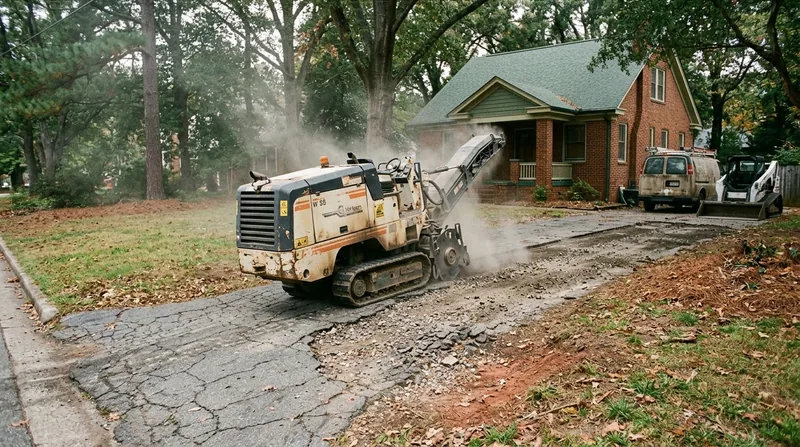




Alligator cracking that runs too deep for a simple overlay, and surface failure that has compromised the structural integrity of your driveway, require asphalt milling and removal in Richmond. We strip the failed top layer down to a base that can still carry your vehicle, leaving sound material underneath that becomes the foundation for new pavement. In Richmond's climate of freeze-thaw cycles, heavy summer rain, and the red Piedmont clay that shifts beneath driveways in neighborhoods from Church Hill to Windsor Farms to Henrico County, milling is often the most cost-effective answer to extensive surface deterioration. Rather than overlay a driveway that has cracked from base failure, we remove the compromised layer, inspect and prepare what remains, and pave fresh. This page explains when milling makes sense, how the work proceeds, what it costs, and how to find a qualified contractor near you.
Why Asphalt Milling Matters in Richmond: When Overlay Stops Working
Richmond driveways fail in predictable patterns. The 1920s brick colonials in Ginter Park and Forest Hill, the Victorian rowhouses in the Fan District with their narrow rear parking pads under willow oaks, the 1950s and 1960s split-level ranches across Chesterfield and Henrico with single-pitch blacktop, and the newer HOA driveways in Short Pump and Glen Allen all face the same problem: after twelve to fifteen years, the surface begins to crack. In the first few years, those cracks are isolated. But as freeze-thaw cycles work their way through Richmond winters, as clay soil shifts and settles, and as the asphalt binder oxidizes in the summer heat, cracks multiply and link into the honeycomb pattern called alligator cracking.
When alligator cracking covers more than thirty to forty percent of the surface, an overlay (a new layer of asphalt over the old) will not hold. The cracks beneath will telegraph through the new surface within two to three years. At that point, the money spent on the overlay is lost. Milling removes that failed layer entirely, stops the cracking at the source, and gives you a solid base for new pavement that will last. The asphalt resurfacing and overlay page explains when overlay is the right choice; this page addresses the cases where it is not.
- We mill away the cracked and failed surface layer, stopping at a base that is still structurally sound.
- Extensive alligator cracking signals that the base has begun to fail, and milling exposes the true condition before new pavement goes down.
- Milling is cheaper than full-depth removal when the base can still carry traffic, and it avoids the cost of hauling away and replacing all the material below.
- A milled surface is rougher and provides better traction for new asphalt, improving adhesion and reducing the risk of the new layer slipping or peeling.
- Milling allows us to inspect for base erosion, settlement, and drainage problems that an overlay would simply hide.
The decision to mill instead of overlay is made on site, after we measure the extent of the cracking and probe the base. That is why a written estimate with tonnage and thickness specifications is essential.
Key info: A driveway in Church Hill or Windsor Farms with heavy alligator cracking across fifty percent of its surface, or a parking lot in Midlothian where the base has begun to erode, is a milling candidate. An overlay on that same driveway will fail within two years. Milling costs more upfront but saves money over the life of the pavement.
For more detail on when to repair, when to resurface, and when to replace, see the driveway repair page. Virginia law requires that any contractor performing milling or excavation work verify utility locations through Virginia 811 before breaking ground. You can file a locate request yourself at virginia811.com, or we can coordinate it as part of the estimate process.
How We Mill and Remove Asphalt in Richmond: Step by Step
Milling is a controlled removal process. We use a milling machine that grinds the top layer of asphalt into small chips, which we collect and haul away. The machine is precise enough to remove only the failed layer and stop at the base, or to mill to a specific depth if the entire surface needs to come off. The work is dusty and loud, but it is fast. A typical driveway milling takes four to eight hours, depending on size and condition.
After milling, the base is swept clean, inspected, and graded if necessary. If there are soft spots, erosion, or drainage problems, we address them before new asphalt goes down. The milled surface is then primed and ready for a new wearing course. The process is the same for residential driveways, parking lots, and private roads.
- We mark utilities through Virginia 811 at least 48 hours before the job begins.
- The milling machine is positioned and calibrated to remove the specified depth, typically two to three inches of failed asphalt.
- We mill the entire surface in passes, collecting chips in a truck or trailer as the machine moves.
- The base is swept, inspected for soft spots or erosion, and graded level if settlement has created low spots.
- Drainage is verified and corrected if needed, ensuring water sheds away from the base and does not pool.
- The milled surface is primed with a tack coat, which helps the new asphalt bond to the base.
- New asphalt is placed and compacted to the specified thickness and density.
The entire cycle from milling to new pavement takes one to three days for most residential jobs, depending on weather and the extent of base repair needed. For a detailed walk-through of how we handle a typical driveway project, see the asphalt driveway paving page.
Local example: A 2,500-square-foot driveway in Lakeside with alligator cracking across sixty percent of the surface and a soft base in the lower section requires milling of the entire surface, regrading of the soft section, and replacement with three inches of new asphalt. The job takes two days. The homeowner can drive on the new surface after 24 to 48 hours, depending on temperature and humidity. New asphalt must cure for six to twelve months before sealcoating is considered.
Milling Methods and Approaches in Richmond
| Approach | Description | Best for |
|---|---|---|
| Shallow Mill (1.5 to 2 inches) | Remove only the top weathered layer, leaving the bulk of the original asphalt intact. | Surface cracking that has not penetrated the base; the base is still sound and level. |
| Full-Depth Mill (2.5 to 4 inches) | Remove the entire asphalt layer, exposing the stone base for inspection and repair. | Alligator cracking across most of the surface, base erosion, or settlement that requires regrading. |
| Selective Mill and Patch | Mill only the worst sections, leaving intact asphalt in good condition, then pave the milled areas. | Cracking concentrated in one area (e.g., a low spot or near a tree), while most of the driveway is sound. |
| Mill and Overlay Combination | Mill failed sections to the base, repair the base, then overlay the entire surface with new asphalt. | Mixed conditions across a large parking lot or private road where some areas need base repair and others need only resurfacing. |
The approach we recommend depends on the extent of the cracking, the condition of the base, and the budget. A site visit and written estimate will specify which method applies to your driveway.
Asphalt Milling and Removal Cost in Richmond: What to Expect
Milling costs in Richmond range widely depending on the size of the area, the depth of milling, and the condition of the base. A typical residential driveway milling (2,000 to 3,000 square feet, two to three inches deep) starts at around $1,500 to $2,500, including base inspection and grading. Larger driveways, parking lots, and private roads scale proportionally. If the base requires significant repair or regrading, the cost rises. If the base is sound and only the top layer needs to come off, the cost is lower.
The main factors that move the price are:
- Size of the area being milled, measured in square feet.
- Depth of milling required, which depends on how much of the asphalt layer has failed.
- Condition of the base, including whether regrading, filling, or drainage work is needed.
- Access and site conditions, such as narrow driveways, trees, or steep slopes that slow the milling machine.
- Haul-away costs for the milled chips, which depend on tonnage and distance to the disposal site.
The only reliable way to know the cost for your driveway is a free site estimate. We measure the area, probe the base, and provide a written quote with tonnage and thickness specifications. Call us at (804) 203-1538 for a free estimate, or visit the pricing page for a detailed breakdown of what drives cost across all our services. You can also check the contact page to request an estimate online.
What to Look for When Hiring an Asphalt Paving Contractor Near Me in Richmond
The paving industry has a reputation for door-to-door fraud. Itinerant crews show up with out-of-state plates, offer a price that sounds too good, ask for a large cash deposit, and disappear. Honest contractors are local, have a verifiable address and local phone number, provide written estimates with tonnage and thickness, and are fully insured. Here is what to check before you hire anyone to mill your driveway.
- Verify that the contractor is fully insured and ask to see a current certificate of insurance.
- Request a written estimate that includes the square footage, depth of milling, tonnage of material to be removed, and the price.
- Ask for references from recent jobs in your area and call at least two to confirm the work and the timeline.
- Confirm that the contractor will coordinate Virginia 811 utility locates before any excavation or milling begins.
- Check whether your driveway is in an HOA or a historic district, and confirm that the contractor understands any architectural or design restrictions that apply.
- Do not sign a contract or make a deposit until you have obtained at least two other written estimates and compared them side by side.
A contractor who is local, provides a detailed written estimate, and is willing to answer questions about base conditions and utility locates is someone you can trust. For more information on choosing a contractor and avoiding scams, contact us at (804) 203-1538 or visit the contact page to request a free estimate.
Asphalt Milling & Removal in Richmond: Pricing Guide
| Service | Price | Details |
|---|---|---|
| Shallow Mill (1.5 to 2 inches) | Starting at $1,500 | Removal of top weathered layer only, with sound base remaining; cost depends on square footage and haul-away distance |
| Full-Depth Mill (2.5 to 4 inches) | Starting at $2,200 | Complete asphalt removal exposing the base for inspection and repair; price increases with base regrading or fill needed |
| Parking Lot or Large Driveway Milling | On estimate | Projects over 5,000 square feet or with complex base conditions require a site visit for tonnage and regrading assessment |
| Mill and Overlay Combination | On estimate | Selective milling of failed sections combined with full-surface overlay; cost varies by extent of failed area and base repair |
| Haul-Away and Disposal | Included | in all estimates; milled chips are removed and disposed of or recycled according to local regulations |
| Free Estimate | Free | Written quote with measurements, tonnage, and thickness; response within 24 hours at (804) 203-1538 |
Indicative pricing, the exact cost depends on square footage, finish, and site access. Free personalized estimate within 24h at (804) 203-1538.


