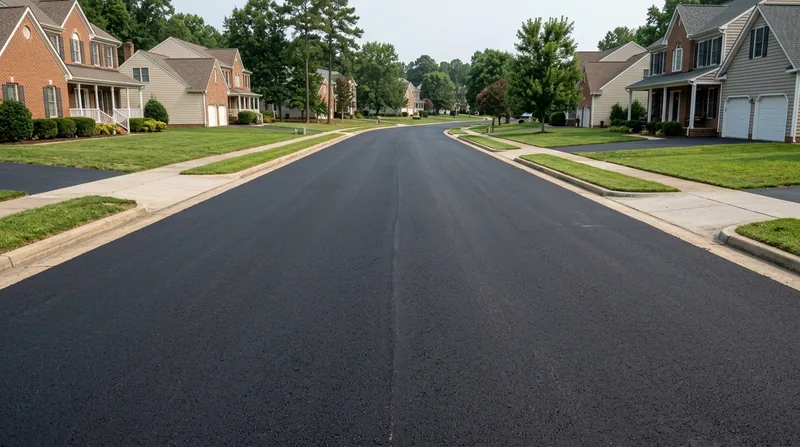




Private Road & HOA Paving in Richmond serves the master-planned subdivisions and gated communities across Central Virginia, where shared driveways and internal roads carry daily traffic across clay-heavy Piedmont soil and through the humid, freeze-thaw cycles that break down asphalt faster than in drier regions. From Short Pump to Glen Allen to Mechanicsville, HOA roads face unique challenges: they must handle volume without the municipal maintenance budgets that public streets receive, they sit under restrictive architectural covenants that govern material and appearance, and they often cross saturated clay that swells in spring and contracts in summer, cracking and heaving the surface. We work with HOA boards and property managers to phase paving across subdivisions so residents maintain access throughout the work, size the base and binder course for the actual traffic load, and navigate local permitting and utility locates that vary from Richmond proper to Henrico County to Chesterfield. A well-built private road or HOA drive lasts fifteen to twenty years with minimal intervention; a poorly built one fails in five to seven, and the repair bill lands on every homeowner. We bring the same rigor to community roads that we bring to individual driveways.
Why Private Road & HOA Paving Matters in Richmond: Clay, Traffic, and Shared Responsibility
HOA roads across Richmond and Henrico County sit in the Piedmont clay belt, where the red earth swells when wet and shrinks when dry, pushing and pulling at the asphalt above it. Winter freeze-thaw cycles in Virginia crack and spall the surface; summer heat softens it under the weight of daily commuter traffic; spring thaw saturates the base, and if that base was not sized correctly or drained properly, the road fails in patches and potholes within a few years. Unlike a private driveway, an HOA road is the responsibility of every resident, and a failed road means a special assessment on every homeowner in the community. Getting it right the first time, or fixing it before it fails catastrophically, is both a financial and a community relations imperative.
- A properly sized base course, compacted in lifts and proof-rolled, distributes traffic load and resists clay heave.
- Drainage design that channels water away from the subgrade prevents saturation and extends pavement life by years.
- Phased construction on multi-phase roads keeps resident access open and avoids the cost and frustration of full closure.
- HOA architectural standards and local permitting rules must be verified before any paving begins, and we help navigate both.
- A written estimate with tonnage specifications and a clear scope prevents cost overruns and protects the HOA budget.
These steps are the difference between a road that lasts two decades and one that demands another paving in seven years.
Key info: Richmond and Henrico County both require Virginia 811 utility locates before any excavation, grading, or base preparation. The HOA board must also verify architectural guidelines and any deed restrictions on material, thickness, or color before work begins. We help coordinate these requirements so the project stays on schedule.
For more on how we repair failed roads and extend pavement life, see our page on asphalt resurfacing and overlay.
How We Pave Private Roads and HOA Subdivisions in Richmond: Phased Approach and Site Coordination
HOA paving is not a one-day job. We start with a site visit and a thorough measurement of the road or roads, including grade, drainage patterns, and any sections that are failing or showing early signs of distress. We then work with the HOA board or property manager to understand traffic volume, budget constraints, and any phasing requirements. For subdivisions with multiple phases, we schedule work in segments so residents can still access their homes and the community can function during construction. We pull measurements and tonnage specs, verify local permit requirements with the municipality, and coordinate Virginia 811 utility locates. Once the scope and timeline are locked, we strip and mill or remove the old asphalt, prepare and compact the base, lay the binder and wearing courses to the thickness required by the traffic load and soil conditions, and finish with edge work and any apron extensions that the HOA or homeowners need.
- We measure the full road or roads and calculate tonnage based on depth, compaction, and the specific asphalt mix required for your traffic and climate.
- We verify local permitting with the city or county and coordinate Virginia 811 utility locates before any excavation or grading begins.
- We work with the HOA board to schedule paving in phases so residents maintain access and the community stays functional throughout the project.
- We strip and mill the old surface or remove it entirely, depending on the condition of the base and the decision to overlay or replace.
- We prepare and proof-roll the base, lay the binder and wearing courses to the specified thickness, and finish with compaction and edge work.
The entire process, from the first site visit to the final compaction, is documented and delivered to the HOA with a summary of materials, labor, and the warranty on our workmanship.
Example: A Short Pump HOA with three internal roads and 120 homes needed a full resurface on all three roads. Residents needed access to their driveways at all times. We phased the work over six weeks, completing one road at a time, so only a small section was closed at any given time. Total tonnage was 280 tons; base prep and drainage improvements added cost upfront but extended the pavement life from an estimated twelve years to eighteen years, saving the HOA money over the long term.
For details on resurfacing versus full replacement, see our page on driveway replacement.
Private Road & HOA Paving Methods: Overlay, Full Replacement, and Milling
| Approach | Description | Best for |
|---|---|---|
| Overlay (Resurfacing) | New asphalt binder and wearing course laid over the existing base, typically 1.5 to 2 inches total. The old surface is not removed. | Roads with sound bases, moderate cracking, and no alligator cracking or heave. Fastest and most budget-friendly option. |
| Mill and Overlay | The top 1 to 2 inches of old asphalt is milled (ground) and removed; a new binder and wearing course are laid on the remaining base. Milled material is recycled or salvaged. | Roads with moderate to heavy distress, surface oxidation, or rutting. Allows full-depth inspection of the base and correction of drainage issues. |
| Full-Depth Replacement | Old asphalt is fully removed; the base is inspected, repaired, and recompacted; a new binder and wearing course are installed. Most expensive option. | Roads with failed bases, severe alligator cracking, clay heave, or poor drainage. Necessary when the subgrade is compromised. |
| Grading and Base Prep | Existing road is stripped to subgrade, graded for proper drainage slope, and a new stone base is installed and compacted in lifts. Asphalt follows after base cures. | New roads, severely failed roads with poor drainage, or roads in clay areas where the base must be rebuilt from scratch. |
Private Road & HOA Paving Cost in Richmond: What to Expect
Private road and HOA paving costs are driven by the scope of work, the condition of the base, the length and width of the road, drainage requirements, and local permitting. A straightforward overlay on a sound base costs less than a full-depth replacement with new base preparation. Most HOA roads in Richmond and Henrico County range from $15,000 to $50,000 or more, depending on the total square footage, the number of phases, and whether grading or drainage work is required. A simple overlay on a half-mile HOA road in Glen Allen might start around $18,000 to $25,000; a full-depth replacement with base work on the same road could reach $35,000 to $50,000 or higher. The only accurate way to know your cost is to have us measure the road, assess the base condition, and provide a written estimate with tonnage and material specs.
Several factors move the price up or down. A road with a failed or saturated base requires more excavation and new stone, which adds cost and time. Drainage improvements, such as installing or repairing culverts or grading for proper runoff, add expense but protect the pavement and extend its life. Phased construction on multi-phase subdivisions requires more setup and mobilization, but it keeps residents happy and avoids the cost of a full closure. Local permitting and utility locates are required by Virginia law and are factored into the estimate. Getting two or three estimates from different contractors is always smart; you will see how each contractor sizes the base, proposes to handle drainage, and prices the work. A bid that is significantly lower than the others often means a thinner base, less compaction, or a shorter warranty, and those shortcuts cost you money within five to seven years.
For a full breakdown of pricing factors and to request a free estimate, visit our pricing page or call us at (804) 203-1538. We provide detailed estimates with tonnage and thickness specs, no obligation.
Private Road & HOA Paving Near Me: What Richmond Homeowners Should Know When Hiring a Contractor
Hiring the right contractor for an HOA road paving project is one of the most important decisions an HOA board makes, because a failed road or a contractor who disappears mid-project leaves every homeowner holding the bill. Before you sign a contract, verify that the contractor is fully insured and ask for proof of general liability and workers compensation coverage. Ask for references from other HOA projects or private road work in the Richmond area, and call those references to ask about the quality of the work, whether the job finished on time and on budget, and whether the contractor was responsive to questions. Get a written estimate that includes the depth and tonnage of asphalt, the base preparation plan, the timeline, and the warranty on the contractor's workmanship. Understand local permitting: Richmond, Henrico County, and Chesterfield all have different rules about driveway aprons, culverts, curb cuts, and impervious surface limits, and some require permits while others do not. Your HOA may also have architectural standards that govern the material, thickness, or color of the paving, and those rules must be checked before work begins. Ask the contractor to verify these requirements and to coordinate Virginia 811 utility locates before any excavation or grading starts. Avoid any contractor who offers a cash-only deal, requests a large deposit upfront, or pushes you to sign a contract on the spot. The strongest signal that a contractor is local and trustworthy is that they have a local address, local plates, and references in your community, not an out-of-state crew that shows up with a quote that is too good to be true.
- Verify that the contractor is fully insured and ask for proof of general liability and workers compensation coverage.
- Request references from other HOA or private road projects in Richmond, Henrico, or Chesterfield, and call those references to ask about quality, timeline, and responsiveness.
- Get a written estimate with depth, tonnage, base preparation plan, timeline, and workmanship warranty clearly stated.
- Verify local permitting requirements with your city or county building department and confirm that the HOA architectural standards allow the proposed paving.
- Confirm that the contractor will coordinate Virginia 811 utility locates before any excavation or grading begins.
- Avoid cash-only deals, large upfront deposits, or contractors who rush you to sign without answering your questions.
If you are ready to move forward, contact us for a free estimate. We work with HOA boards across Richmond, Glen Allen, Short Pump, and Mechanicsville, and we respond within 24 hours.
Private Road & HOA Paving in Richmond: Pricing Guide
| Service | Price | Details |
|---|---|---|
| Overlay (Resurfacing) on Sound Base | Starting at $15,000 | New binder and wearing course on existing base; cost depends on road length, width, and whether drainage work is needed |
| Mill and Overlay | Starting at $22,000 | Top asphalt layer milled and removed, new courses installed; includes base inspection and correction of minor drainage issues |
| Full-Depth Replacement with Base Work | Starting at $35,000 | Complete removal, base rebuild, grading, and new asphalt; required when base is failed or saturated clay needs rework |
| Grading, Drainage, and Base Preparation | On estimate | New roads or severely compromised subgrade require site assessment; culvert work, slope correction, and stone base cost varies by scope |
| Phased HOA Construction | On estimate | Multi-phase subdivisions require separate mobilization and scheduling; we coordinate access and resident convenience throughout project |
| Estimate and Site Visit | Free | We measure, assess base condition, verify local permits, and provide written tonnage specs within 24 hours at (804) 203-1538 |
Indicative pricing, the exact cost depends on square footage, finish, and site access. Free personalized estimate within 24h at (804) 203-1538.


