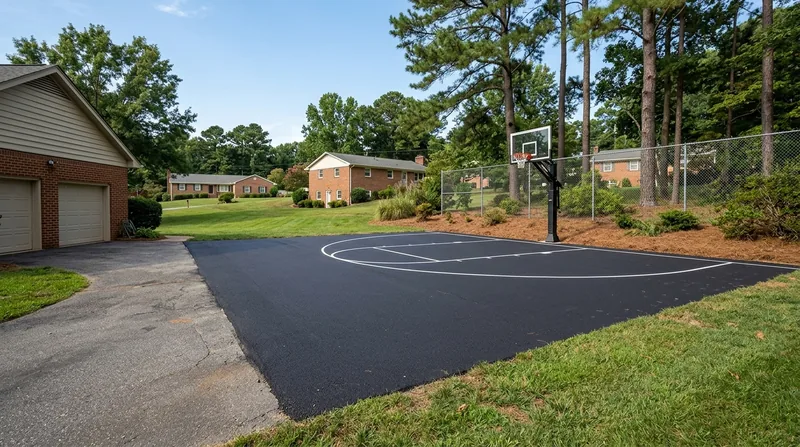




A sports court and path paving project in Richmond demands more than smooth asphalt. The red Piedmont clay that underlies much of the city, combined with humid summers and the region's heavy afternoon thunderstorms, means that drainage and base preparation are the difference between a court that plays true for years and one that cracks, settles, or sheds water into a homeowner's property. Whether you are building a basketball court in Short Pump, a tennis court in Windsor Farms, or a walking path at a private residence in Goochland, the foundation must be engineered for Richmond's specific soil and climate. We grade for slope, prepare a stable base, and lay hot mix asphalt sized for the daily play and weather exposure your court will see.
Why Sports Court and Path Paving Matters in Richmond's Residential Landscape
Richmond's neighborhoods span from the dense brick rowhouses of the Fan District, where rear alleys host small parking pads under towering willow oaks, to the sprawling estates of Windsor Farms with their long curving driveways, and out to rural properties in Goochland and Powhatan where gravel and tar-and-chip roads dominate. A sports court sits somewhere in between: it is a permanent recreational fixture that must drain reliably, support equipment and foot traffic, and withstand the freeze-thaw cycles of Virginia winters and the clay-soil expansion of humid summers. Poor drainage on a sports court doesn't just create puddles; it accelerates subsurface erosion, causes the asphalt to settle unevenly, and can damage the playing surface within a single season.
- We establish proper slope and drainage patterns so water runs off the court instead of pooling or migrating into the surrounding soil.
- We compact the base in layers to handle Richmond's red clay and prevent settling under the weight of play and equipment.
- We size the asphalt mix for the climate and expected use, so the court remains stable through summer heat and winter freeze cycles.
- We respect local setback requirements and work with your HOA or municipal building department to ensure the court meets Richmond's specific codes.
Getting the base right the first time saves thousands in repairs and keeps your court playable for a decade or more.
Key info: Virginia law requires that any excavation or grading work must be preceded by a utility locate through Virginia 811. If your court project involves clearing trees, regrading, or installing drainage, we coordinate these locates before any work begins. This protects underground gas, electric, water, and communication lines on your property.
For more on how we prepare sites and manage drainage on larger residential projects, see our page on gravel driveway installation and grading, which covers the same base-prep principles.
How We Build a Sports Court or Path in Richmond: Step by Step
A sports court is not a standard driveway. The tolerances are tighter, the slope must be consistent, and the surface has to support lateral movement and precise ball roll. Our process begins with a site visit to assess drainage, soil conditions, and access. We then remove any existing pavement or debris, grade the lot to ensure water runs off (typically a 1 to 2 percent slope away from structures), install or repair drainage if needed, and prepare a stable compacted base. Once the base is proven, we lay hot mix asphalt in the thickness required for your court type and expected traffic.
- We visit your property to measure, assess soil and drainage, and identify any site constraints such as tree roots, utility lines, or steep terrain.
- We remove old pavement and debris, then excavate and grade the lot to the proper slope for runoff.
- We compact the base material in layers, proof-roll it to verify stability, and correct any soft spots before asphalt is laid.
- We lay hot mix asphalt at the thickness your court requires, typically 2 to 3 inches for a residential basketball or tennis court.
- We finish the surface smooth and allow it to cure for 24 to 48 hours before the court is ready for play.
The entire process typically takes one to three weeks, depending on site conditions and weather. We provide written estimates that specify the tonnage of asphalt, the base preparation method, and the slope and drainage plan.
Example: A residential tennis court in the Fan District required excavation of a sloped rear yard, removal of compacted clay, installation of a gravel base, and 2.5 inches of hot mix asphalt. The site had no utility conflicts and good drainage to an alley. The project took ten working days and cost within the typical range for a 2,500-square-foot court.
See our service page on asphalt driveway paving and installation for more on how we lay asphalt and manage the curing process.
Sports Court and Path Paving Methods
| Approach | Description | Best For |
|---|---|---|
| Full-Depth Court Installation | Complete site prep, excavation, graded base, compacted layers, and new hot mix asphalt, typically 2 to 3 inches thick. | New courts or sites with poor existing drainage or unstable soil. |
| Overlay on Existing Base | Milling the top layer of an old court, recompacting the base if needed, and laying new asphalt over it. | Courts with sound bases but worn or cracked playing surfaces. |
| Walking Path or Lane Paving | Narrower asphalt paths, 4 to 8 feet wide, with graded base and 1.5 to 2 inches of asphalt, designed for pedestrian traffic. | Connecting paths between properties, estate lanes, or accessible routes around residential grounds. |
| Gravel or Tar-and-Chip Alternative | Compacted gravel base with recycled asphalt millings or tar-and-chip surface, lower cost and less visual impact. | Rural properties, informal courts, or where budget and aesthetics favor a softer surface. |
Sports Court and Path Paving Cost in Richmond: What to Expect
A residential sports court in Richmond typically starts at $8,500 for a small basketball court or tennis court with standard site prep and asphalt. Larger courts, complex drainage, poor soil conditions, or tree removal can increase the cost significantly. A full-depth court installation on a sloped lot in Midlothian or Glen Allen, where grading and drainage work is more involved, may run $12,000 to $18,000. Walking paths are typically less expensive, starting around $3,000 to $5,000 for a 50-foot lane with proper base and asphalt.
The main factors that affect your final cost are the size of the court or path, the condition and slope of the existing ground, the depth of excavation and base prep required, the proximity of trees or utilities, and whether drainage work is needed. A flat lot with good drainage and no tree roots will be less expensive than a sloped lot in clay soil with existing vegetation. We always provide a written estimate that includes the square footage, the tonnage of asphalt, the base preparation method, and the slope and drainage plan.
Getting two or three estimates from local paving contractors is the best way to understand the range and to verify that you are comparing the same scope of work. Our estimate is free and comes with no obligation to book. Call us at (804) 203-1538 or visit our pricing page for more details on how we structure estimates and what the typical range is for different court sizes and site conditions.
Sports Court and Path Paving Near Me: What Richmond Homeowners Should Know When Hiring
Choosing a paving contractor for a sports court is different from hiring one for a driveway. The court is a precision surface, and the contractor must understand drainage, slope, and base stability. Before you hire, verify that any contractor you are considering is fully insured and carries a current Virginia contractor license for asphalt paving work. Virginia law requires a state license (Class A, B, or C, depending on contract value) for paving projects, and you should ask any contractor for proof of that license. Check references from similar projects, ask whether the contractor provides a written estimate with tonnage and thickness specifications, and confirm that they will coordinate utility locates through Virginia 811 before any excavation or grading begins.
If your property is in an HOA community such as those in Short Pump, Tuckahoe, or Lakeside, check your architectural guidelines before you plan the court. Some HOAs restrict the size, location, or materials of recreational structures. We help you navigate these requirements and work with your HOA to ensure the court meets all local standards. If your lot is near protected or heritage trees, or if you are in a historic district, there may be additional permits or approvals needed. We coordinate with your local building department to ensure all work is done within code.
For a free estimate and to discuss your specific court or path project, contact us at (804) 203-1538. We serve Richmond and surrounding areas including Glen Allen, Short Pump, Mechanicsville, Ashland, and Goochland, and we are available for estimates within 24 hours.
Sports Court & Path Paving in Richmond: Pricing Guide
| Service | Price | Details |
|---|---|---|
| Small basketball or tennis court (2,000-2,500 sq ft) | Starting at $8,500 | Includes full-depth prep, compacted base, and 2.5 inches of hot mix asphalt on level to gently sloped sites |
| Large court or complex site (3,000-4,500 sq ft) | Starting at $12,000 | Steeper slopes, extensive grading, drainage work, or difficult soil conditions increase the base prep and labor cost |
| Walking paths or lanes (4-8 ft wide, 50-200 ft long) | Starting at $3,000 | Narrower surfaces with lighter asphalt depth, suitable for connecting paths and residential estate lanes |
| Overlay on existing court with sound base | Starting at $5,500 | Milling, base recompaction, and new asphalt surface; cost depends on milling depth and square footage |
| Travel and estimate | Included / Free | No mileage fee or call-out charge within Richmond and surrounding service areas; free written estimate within 24 hours |
Indicative pricing, the exact cost depends on square footage, finish, and site access. Free personalized estimate within 24h at (804) 203-1538.


